
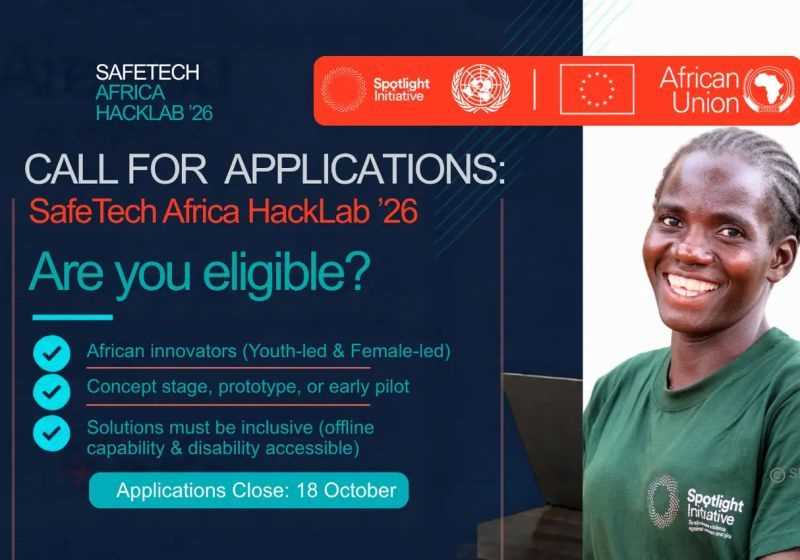
Seed grants ranging from USD 5,000 to USD 10,000 per winner : Apply for the SafeTech Africa HackLab ’26 – Innovating for Safe Spaces
Applications are open for the SafeTech Africa HackLab ’26, a youth social innovation challenge supporting African innovators developing technology-driven solutions that make physical, informational and digital spaces safer for women, girls and young people.
The initiative is organized by UNFPA Eastern and Southern Africa and Western and Central Africa, in partnership with the Spotlight Initiative Africa Regional Programme (SIARP 2.0), Global Programme to End Child Marriage, African Union Innovation Lab, UNDP, UNICEF and UN Women.
The HackLab is designed to identify, support and fund practical youth-led innovations addressing issues such as technology-facilitated violence, child marriage, female genital mutilation (FGM), online harassment, harmful practices and digital rights.
Applications are open until 18 October 2026 at 23:59 CAT.
About SafeTech Africa HackLab ’26
The SafeTech Africa HackLab: Innovating for Safe Spaces, Digital Sovereignty & Rights was launched during the African Union Innovation Festival ’26 in Addis Ababa under the theme “Vibrant Youth Ecosystems for AI & Digital Sovereignty.”
The programme provides a platform for young African innovators, social entrepreneurs and digital rights advocates to develop solutions to challenges affecting women, girls, youth and marginalized communities.
Selected innovators will receive virtual mentorship using the UNFPA Social Innovation Toolkit and will have an opportunity to present their solutions during a showcase and final pitch event at the YouthConnekt Africa Summit in November 2026.
Three Challenge Themes
Applicants must submit their innovation under one of three priority themes.
1. Safe Physical & Community Spaces
This theme focuses on preventing and responding to harmful practices such as child marriage, FGM and technology-facilitated violence against women and girls.
Solutions should use digital, mobile or civic technology to strengthen physical and community safety, particularly for young people who are at risk of or affected by violence and harmful practices.
Potential solutions could include:
- SMS, USSD or app-based early-warning and referral systems
- Digital tools supporting school retention and child marriage prevention
- Interactive storytelling and community dialogue platforms
- Youth-led referral and safe-space networks
- Digital systems connecting vulnerable girls with protection, legal, health and emergency services
2. Safe Informational Spaces
This theme addresses the need for young people to access accurate, age-appropriate and confidential information relating to comprehensive sexuality education (CSE) and sexual and reproductive health and rights (SRHR).
Innovations could create secure digital environments where young people can access reliable information, discuss issues safely and connect with appropriate services.
Examples include:
- Youth-friendly chatbots and messaging platforms
- USSD-based information services
- Interactive digital learning platforms
- E-learning applications for rural and out-of-school youth
- Accessible tools designed for young people with disabilities
- Peer-to-peer digital spaces
- Confidential platforms for service referrals and bookings
3. Safe Digital Spaces
The third theme focuses on creating safer online environments and addressing technology-facilitated violence against women and girls (TF-VAWG), anti-rights narratives, disinformation and digital censorship.
Applicants are encouraged to consider solutions that strengthen digital safety, privacy, critical media literacy and the ability of users to respond to online harm.
Possible innovations include:
- Safety-by-design digital tools
- Browser extensions and digital self-defence platforms
- Encrypted reporting systems
- Tools for identifying and countering online disinformation
- Media literacy applications
- Privacy-preserving AI solutions
- Tools addressing online harassment and deepfakes
- Decentralized and privacy-preserving platforms for human rights advocates and creators
How Applications Will Be Evaluated
Applications will be assessed against several criteria, with a total of 100 points available.
The assessment will consider:
Problem-Solution Fit: How effectively the proposed innovation responds to the identified challenge.
Innovation and Originality: The creativity, novelty and relevance of the proposed solution.
Feasibility and Viability: Whether the idea has a realistic 12-month implementation roadmap, outputs and milestones.
Inclusivity and Accessibility: How effectively the solution reaches communities with limited connectivity, low digital literacy and people living with disabilities.
Youth Leadership: The extent to which young people, particularly young women, lead the design, implementation and ownership of the solution.
Scalability and Impact: The potential to expand the solution beyond an initial community and demonstrate measurable results.
Safety, Privacy and Ethics: Consideration of safeguarding, responsible technology use, data protection and ethical AI principles.
What Applicants Need to Submit
Applications must be completed online and should include information such as:
- Details of the team lead and team members
- Age, gender composition, nationality, contact information and roles
- Selection of one challenge theme
- A problem statement of no more than 200 words
- An innovation description of no more than 700 words
- A 12-month implementation roadmap, including outputs and milestones
- A digital safety and inclusion note covering safeguarding, data privacy and accessibility
The proposed solution should clearly explain the problem being addressed, the people or communities affected, how the technology or innovation works, its expected benefits and how it could eventually be scaled.
Important Considerations
The HackLab is particularly interested in practical, youth-led innovations rather than ideas without a clear pathway toward implementation.
Solutions should demonstrate consideration for people who may face barriers such as limited internet access, low digital literacy or disability. Applicants should also demonstrate responsible approaches to privacy, safeguarding, ethical technology and potential digital risks.
The deadline to apply is 18 October 2026 at 23:59 CAT.
Scroll down for more details and click on the official link attached to apply for this opportunity.
Additional Information
- Four winning innovations will receive seed grants ranging from USD 5,000 to USD 10,000 per winner.
- In addition, selected innovators can benefit from:
- Virtual mentorship and support
- Pitch coaching for shortlisted finalists
- Opportunity to present at the YouthConnekt Africa Summit in November 2026
- Exposure to investors, venture funds and development partners
- Market access and investor matchmaking opportunities
- Continental visibility through UNFPA, Spotlight Initiative and African Union media channels
- Opportunities to develop and strengthen solutions with potential for wider impact
- Young technology innovators and developers
- Social entrepreneurs
- Female innovators
- Digital rights advocates
- Youth-led teams developing practical solutions to social challenges
- Applicants are expected to check the official eligibility requirements carefully, including the applicable residency and country requirements.


Seed grants ranging from USD 5,000 to USD 10,000 per winner : Apply for the SafeTech Africa HackLab ’26 – Innovating for Safe Spaces 0 reviews
Login to Write Your ReviewThere are no reviews yet.
