


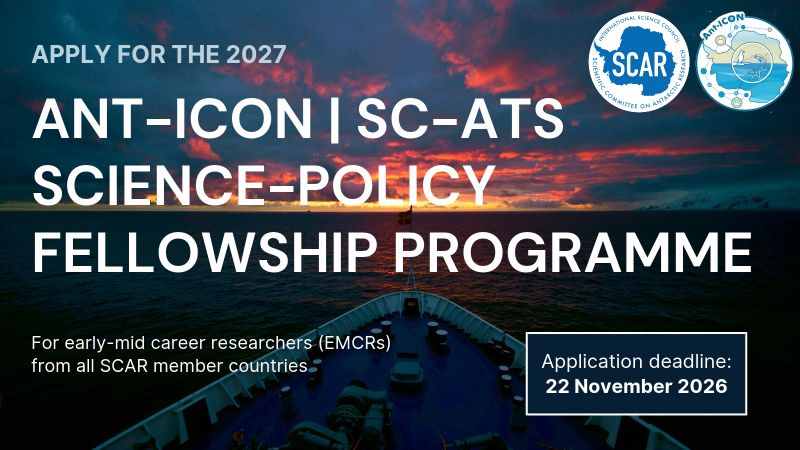
FUNDED : Apply for the 2027 SCAR Ant-ICON/SC-ATS Science-Policy Fellowship Programme
Description
Applications are open for the 2027 SCAR Ant-ICON/SC-ATS Science-Policy Fellowship Programme, an international opportunity supporting early- to mid-career researchers who want to strengthen the connection between Antarctic scientific research and policymaking.
The programme offers two fellowships for researchers from countries that are members of the Scientific Committee on Antarctic Research (SCAR). Selected fellows will gain first-hand experience participating in international Antarctic policy forums, work with experienced mentors and explore how scientific evidence can inform decisions on Antarctic and Southern Ocean conservation.
About the Fellowship
The fellowships are jointly supported by SCAR’s Standing Committee on the Antarctic Treaty System (SC-ATS) and its Integrated Science to Inform Antarctic and Southern Ocean Conservation research programme (Ant-ICON).
The initiative aims to address barriers that prevent researchers, particularly those early in their careers and those from emerging Antarctic nations, from engaging in international policy discussions. Through practical exposure to Antarctic governance and science-policy processes, fellows will develop policy literacy, strengthen their research impact and build skills that can support their future careers.
Fellowship Opportunities
Two fellowships are available for 2027, with each fellow participating in a different international policy forum.
- Antarctic Treaty System Fellowship: Participation in the Committee for Environmental Protection (CEP) and Antarctic Treaty Consultative Meeting (ATCM), scheduled for 17–27 May 2027 in Incheon, Republic of Korea.
- Antarctic Marine Conservation Fellowship: Participation in the Scientific Committee of CCAMLR (SC-CAMLR) and the Commission for the Conservation of Antarctic Marine Living Resources (CCAMLR) meetings in Hobart, Tasmania, Australia, in October 2027.
Both fellows will attend their respective meetings as members of the SCAR delegation.
Fellowship Activities
The programme is organised around three main phases.
1. Preparation before the meetings
Fellows will work with their mentors to prepare a draft background, information or working paper informed by their research. They will review relevant meeting documents and participate in preparatory discussions with the SCAR delegation and, where appropriate, their national delegation. Submission of the paper will depend on its suitability and the relevant review process.
2. Participation in international policy forums
Fellows will attend the full duration of their respective meetings, engage with delegates and gain practical insight into how scientific knowledge is considered in Antarctic policy and conservation decisions. Opportunities to present their work may be available, depending on the meeting and its arrangements.
3. Reporting and knowledge-sharing
Following the meetings, fellows will prepare a report outlining their experience, learning and the potential influence of the fellowship on their future careers. Where possible, they may also undertake outreach activities to share knowledge and strengthen science-policy capacity among other researchers in their home countries.
Applicants are expected to have research that is sufficiently developed to inform policy-relevant advice. Preference will be given to candidates who have not already had extensive experience attending the relevant international meetings.
Ideally, applicants will have a relevant research paper that has recently been published or is under review. The selection committee will assess the relevance of each applicant’s research to the relevant policy priorities, as well as the information provided in the application.
Applicants should clearly explain how their research can contribute to Antarctic policy discussions and ensure that their employer or supervisor supports their participation where required.
The SCAR Ant-ICON and SC-ATS review group will jointly assess applications and select the two fellows.
Researchers working on Antarctic science, environmental conservation and related policy issues are encouraged to review the eligibility criteria and submit their applications before the deadline.
Don’t miss out on the application deadline which is 22 November 2026.
Scroll down for more details and click on the official link attached to apply for this opportunity.
Additional Information
Host Institution
SCAR’s Standing Committee on the Antarctic Treaty System (SC-ATS) and its Integrated Science to Inform Antarctic and Southern Ocean Conservation research programme (Ant-ICON)
Program Type
Fully Funded
Program Benefits
The programme provides financial and professional support to help selected researchers participate in Antarctic policy discussions.
- Travel support: Funding for travel to the relevant meetings.
- Accommodation: Accommodation costs covered during meeting attendance.
- Daily subsistence: Financial support for daily living expenses associated with attending the meetings.
- Expert mentorship: Guidance from experienced SCAR researchers and policy experts.
- Policy engagement: First-hand exposure to Antarctic governance, international negotiations and science-policy discussions.
- Research-to-policy experience: Support in preparing a science-policy paper for potential submission to the relevant meeting.
- Professional development: Opportunities to expand professional networks, strengthen policy communication skills and improve the practical impact of research.
The fellowship does not provide funding for salary hours or the time spent preparing for the meetings.
Eligibility Criteria
The fellowship is open to early- and mid-career researchers from SCAR member countries who meet the following requirements:
- Be an early- to mid-career researcher at postgraduate level or above, with up to 15 years since completing a PhD. Research breaks are taken into account.
- Be actively engaged in Antarctic research relevant to the Committee for Environmental Protection (CEP), Antarctic Treaty Consultative Meeting (ATCM), CCAMLR or SC-CAMLR.
- Have research that can inform relevant policy priorities or address an emerging issue requiring policymakers' attention.
- Have support from their employer or research supervisor, where applicable, to undertake the preparation and meeting commitments.
Eligible Countries
ALL COUNTRIES

There are no reviews yet.
Review
Login to Write Your Review
Author Info
